Aggregate only
We run grouped counts and medians, nothing else. Names, phone numbers, email addresses, street addresses, free-text messages and payment fields are never read, exported or published.

Research methodology
The rules behind every statistic on this site: where the 2,678 inquiries come from, what is measured, what is left out, and how to read the grades.
Start your trip
Tell us the basics. We’ll help with the rest.
Summary
If a statistic appears anywhere on this site, it came from one place. There is no second source, no national dataset and nothing borrowed from an industry report.
That place is 2,678 Phoenix-area trip inquiries received from June 2023 to September 2026 through Phoenix Party Bus and affiliated Phoenix-market booking channels. We publish grouped counts and medians only, never a finding with fewer than 40 records behind it, and we call the results inquiries and historical quotes rather than bookings and prices.
The findings themselves live on the Phoenix transportation data page. This page is about how they were made.
Publication rules
We run grouped counts and medians, nothing else. Names, phone numbers, email addresses, street addresses, free-text messages and payment fields are never read, exported or published.
A finding goes up only when at least 40 records sit behind it. Anything smaller gets dropped rather than published with a warning label on it.
Percentages are rounded to whole numbers, and so are quote medians, which is why they read as about $1,250 rather than to the dollar. Shares within a finding can total 99 or 101.
Fields on an inquiry are optional, so each finding reports its own n instead of borrowing the headline 2,678.
Every sentence describes what people asked for. We do not record which requests became trips, so we make no claims about bookings, revenue or market share.
Quote medians span more than three years and a lot of vehicle types. They are history, not an offer and not a rate card.
What is measured
Plenty of people send us a date and a phone number and nothing else, which is completely fine for booking a bus and awkward for counting things. So coverage differs by field.
The counts below are the largest sample available for each one.
| Field | Records | Used for |
|---|---|---|
| Event dateDay of week and month of the requested trip. Drives the weekday and seasonality findings. | 2,336 | Day of week and month of the requested trip. Drives the weekday and seasonality findings. |
| Inquiry date and event dateDays between the inquiry and the event. Drives the planning-window findings. | 2,580 | Days between the inquiry and the event. Drives the planning-window findings. |
| Passenger countRequested group size. Drives the group-size bands and medians. | 1,809 | Requested group size. Drives the group-size bands and medians. |
| Stated occasionEvent type chosen or stated by the customer, such as prom, wedding, or birthday. | 1,057 | Event type chosen or stated by the customer, such as prom, wedding, or birthday. |
| Quoted vehicle typeCategory of vehicle quoted: party bus, Sprinter limo, or stretch limousine. | 717 | Category of vehicle quoted: party bus, Sprinter limo, or stretch limousine. |
| Recorded quoteTotal quoted for the trip. Reported only as medians and labeled as historical quotes. | 484 | Total quoted for the trip. Reported only as medians and labeled as historical quotes. |
| Stated trip lengthHours requested. Drives the trip-length finding. | 473 | Hours requested. Drives the trip-length finding. |
Definitions
Four words do most of the work on the data page. Here is exactly what each one counts, so nothing you quote gets stretched by accident.

Confidence grades
Every finding carries a grade, and it tells you one thing: how much data is holding it up. Of the 78 published findings, 12 are grade A, 26 are grade B and 40 are grade C.
Grade A
1,000 or more records
Market-wide patterns such as weekday, month, group size, and lead time. Stable.
Grade B
200 to 999 records
Large segments such as bachelorette trips, birthdays, trip length, and overall quotes. Reliable.
Grade C
40 to 199 records
Single-event breakdowns such as prom, weddings, and concerts. Directional.
A grade C finding is still worth using. When 83% of Phoenix prom inquiries are for a Saturday, the exact figure might be a couple of points off, but the point made in the prom party bus guide — that every family wants the same handful of nights — does not move.
Phoenix Party Bus data
Four findings from one measure, each with its own sample size and grade.
66 days
Big groups plan roughly three times earlier than small ones. If you are moving 40+ people, two months of runway is typical.
31 days
A month ahead is normal. Earlier gets you first pick of sizes; later still works, with fewer options.
26%
Last-minute trips happen constantly. Call instead of emailing when you are inside two weeks so availability can be checked live.
38%
Small groups decide late and usually still find a limo or Sprinter. Big groups do not have that luxury.
Source: Phoenix Party Bus inquiry data, June 2023–September 2026 (2,678 Phoenix-area inquiries). Inquiries are not bookings; historical quotes are not current prices. See the full data · Methodology
How the site uses the data
All the findings sit in one source file, each with an ID, a short statistic, a sentence that is safe to quote, a plain takeaway, a sample size and a grade.
Pages pull from that file instead of retyping numbers. So when a wedding transportation page and a coach bus page both mention the 77-day wedding planning window, they are reading the same record. Fix it once and it is fixed everywhere.
Our planning tools carry the same labels. Whatever the party bus cost estimator shows you is a budgeting aid built on history. Only a quote for your actual date is a price.
Opinions stay on their own side of the fence. The rider polls are self-selected votes from site visitors, and they never get mixed into these findings.
Streets, airports, venues and weather are not in the inquiry data, so we point you at the agency that owns the answer. Closures, airport rules and heat warnings change faster than any web page does, and a stale number is worse than a link. The registry below lists those sources.
Used across location, venue, and event pages for information that the inquiry data cannot provide. Source set reviewed August 2, 2026.
Traffic Restrictions and Street Closures
City of Phoenix Street Transportation Department
Current Phoenix street restrictions, closures, and event-related access changes.
Major Events Planning Resources
City of Phoenix
Official event-planning, venue, permit, and street-closure resources.
Ground Transportation Support
Phoenix Sky Harbor International Airport
Commercial ground-transportation permits, terminal maps, waiting areas, and airport operating information.
AZ511 Traveler Information
Arizona Department of Transportation
Real-time Arizona highway delays, crashes, construction, closures, cameras, and alternate routes.
Rail2DTPHX Event Transportation
Valley Metro
Downtown event rail stops, park-and-ride options, and multimodal arrival planning.
Phoenix HeatRisk and Heat Safety
National Weather Service Phoenix
Current Phoenix HeatRisk guidance and heat-related planning considerations.
Monsoon Safety
National Weather Service Phoenix
Dust, wind, flash-flood, lightning, and heat guidance during Arizona monsoon season.
Plan Your Meeting in Greater Phoenix
Visit Phoenix
Convention, hotel, venue, and regional meeting-planning context.

Celebrations
Wedding party in one vehicle, guests in another, and every move on a schedule the venue can follow.

School Events
One bus, one itinerary parents have signed off on, and room for the whole group from driveway photos to the ride home.

Celebrations
The bus is the party for most Valley birthdays. Pick the size, pick the stops, and nobody drives.
Sports
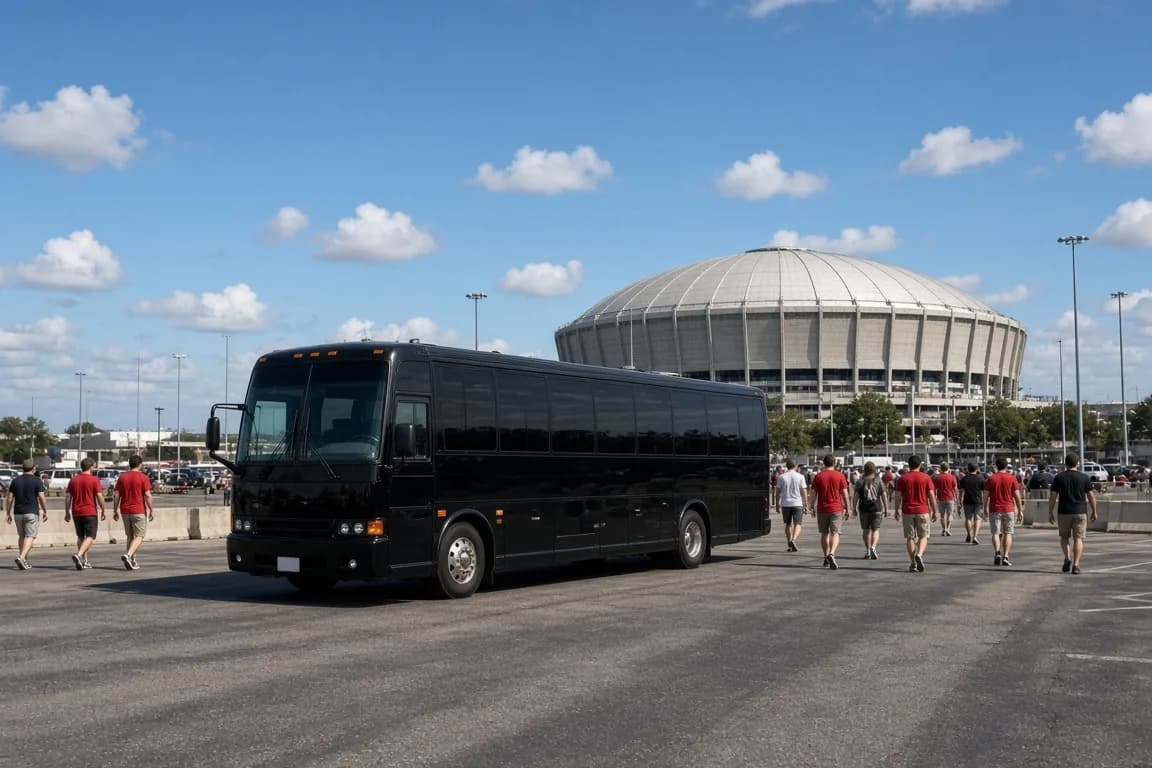
Suns, Cardinals and Diamondbacks games with the group in one bus and the pregame on board.
Planning tools
See what Phoenix groups your size have been quoted, by hours and day
Open the toolAlready know your headcount? See every vehicle that seats it, and how much slack each one leaves.
Open the toolCount down to your date, with a checklist matched to how long you've got
Open the toolYour turn
Vote to see how other riders answered. Results update live, and no sign-up is needed.

Straight answers on minimum hours, deposits, what is included, and what to bring.
Still have questions? Call or text (480) 347-0743
Have your pickup ZIP, date, group size, and hours ready and we can quote the same day.
Call or send a note. For trip quotes, the form at the top of the page is fastest.